We live in a globalised world, but what does this really mean? Put simply, globalisation is the process of our increasing interdependence on each other across the world, for what we buy, our culture and even our beliefs.
While globalisation is not a new process, it has sped up since 1945, and is having many effects on how we live, the environment, governments, economic development and human well-being around the world.
This interconnectedness is sometimes also referred to as the 'global village' where borders and distance become less relevant and the world, figuratively, a smaller place.
Many of the impacts of globalisation are beneficial, but Jimmy Carter, a former US President, has pointed out that many people are missing out on the benefits:
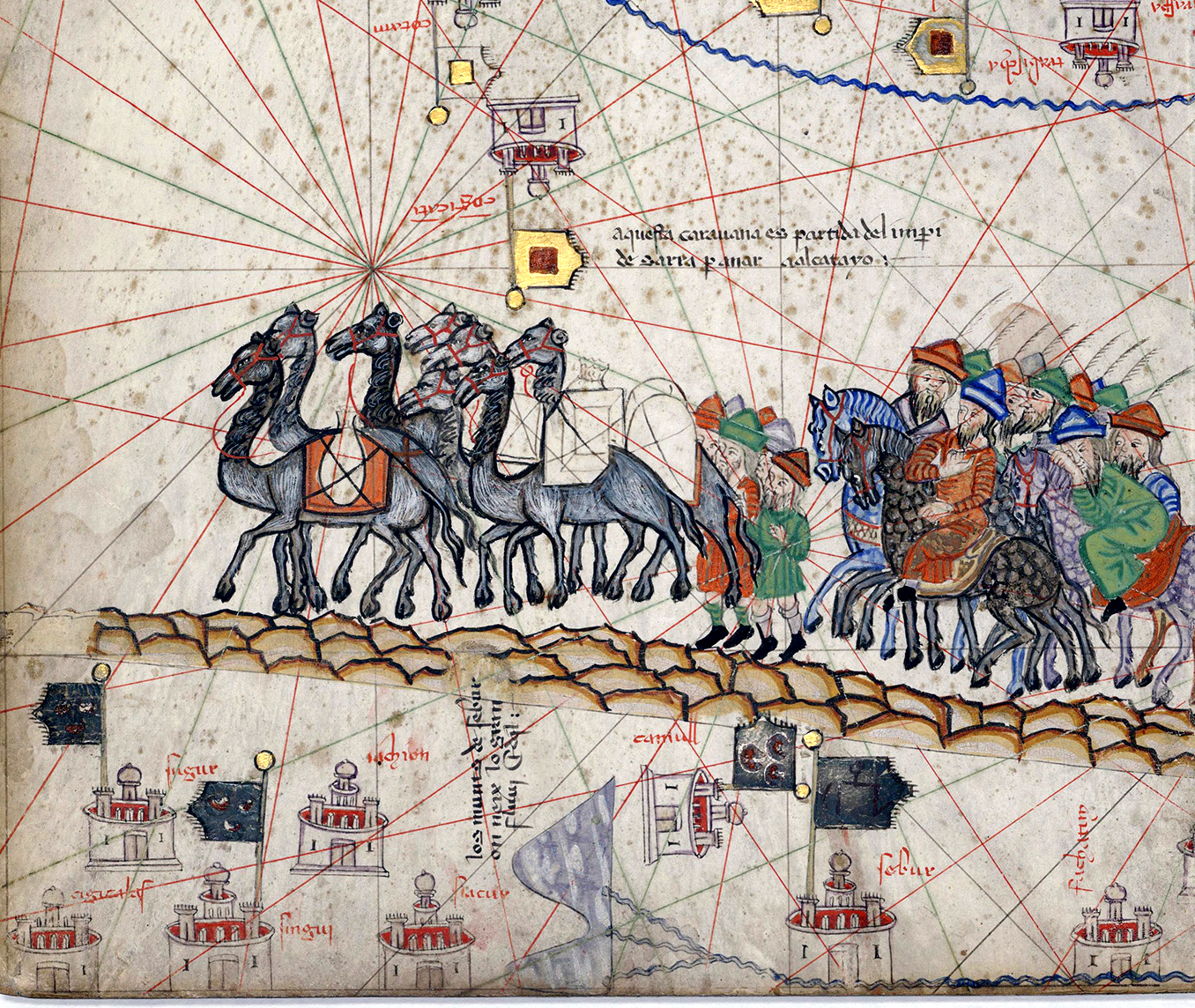 Caravan on the Silk Road, 1380, from Wikipedia[/caption]
Connections between different parts of the world started in ancient times, with the establishment of trade routes such as the Silk Road across Central Asia, connecting China and Europe as early as the second century BC. By the end of the 19th century, countries became even more closely connected, as transport became much easier and quicker using steamships and railways. Cultures were linked as migrant labour helped the development of the world’s richest countries, such as the USA. However, not everyone benefited from globalisation; the Transatlantic Slave Trade, for instance, saw over ten million Africans shipped to the Americas between the 16th and 19th centuries. The legacy of this inequality has helped shape our globalised world today.
When we think of globalisation, it is often in terms of economic globalisation: for instance our interdependence through global trade, the importance of multinational companies, and increasing information flows through technology. Economic globalisation is having a profound impact on how we live; however, it’s worth noting that there are other aspects of globalisation.
Environmental globalisation reflects the increasingly global effects of human activity on the environment, and the effects of global environmental changes on people. While experts argue that globalisation has contributed towards climate change, bringing down greenhouse gas emissions, and mitigating against the effects of climate change will need global cooperation.
Cultural globalisation deals with the connections among languages, and ways of living – while cultural exchange is a huge benefit, some argue that the domination of huge multinational companies, the English language and North American and European cultures is leading to global cultural homogenisation.
Political globalisation includes a wider acceptance of global political standards such as human rights, democracy, the rights of workers, environmental standards, as well as the increased coordination of actions by governments and international agencies such as the European Union, World Bank or United Nations. For instance, the Millennium Development Goals, replaced in 2015 by the Sustainable Development Goals, represent global targets for cutting poverty and tackling challenges such as climate change.
For more background, browse through articles on the Guardian Globalisation web pages, or watch this TED Talk focusing on Globalisation.
This 8-minute video clip also provides a useful overview.
[embed]https://youtu.be/3oTLyPPrZE4[/embed]
Caravan on the Silk Road, 1380, from Wikipedia[/caption]
Connections between different parts of the world started in ancient times, with the establishment of trade routes such as the Silk Road across Central Asia, connecting China and Europe as early as the second century BC. By the end of the 19th century, countries became even more closely connected, as transport became much easier and quicker using steamships and railways. Cultures were linked as migrant labour helped the development of the world’s richest countries, such as the USA. However, not everyone benefited from globalisation; the Transatlantic Slave Trade, for instance, saw over ten million Africans shipped to the Americas between the 16th and 19th centuries. The legacy of this inequality has helped shape our globalised world today.
When we think of globalisation, it is often in terms of economic globalisation: for instance our interdependence through global trade, the importance of multinational companies, and increasing information flows through technology. Economic globalisation is having a profound impact on how we live; however, it’s worth noting that there are other aspects of globalisation.
Environmental globalisation reflects the increasingly global effects of human activity on the environment, and the effects of global environmental changes on people. While experts argue that globalisation has contributed towards climate change, bringing down greenhouse gas emissions, and mitigating against the effects of climate change will need global cooperation.
Cultural globalisation deals with the connections among languages, and ways of living – while cultural exchange is a huge benefit, some argue that the domination of huge multinational companies, the English language and North American and European cultures is leading to global cultural homogenisation.
Political globalisation includes a wider acceptance of global political standards such as human rights, democracy, the rights of workers, environmental standards, as well as the increased coordination of actions by governments and international agencies such as the European Union, World Bank or United Nations. For instance, the Millennium Development Goals, replaced in 2015 by the Sustainable Development Goals, represent global targets for cutting poverty and tackling challenges such as climate change.
For more background, browse through articles on the Guardian Globalisation web pages, or watch this TED Talk focusing on Globalisation.
This 8-minute video clip also provides a useful overview.
[embed]https://youtu.be/3oTLyPPrZE4[/embed]
While there’s some truth in this sentiment, it’s also true that mobile technology is actually having a positive impact in some of the poorest countries in the world. Globalisation presents huge opportunities and challenges for today's students, and can generate discussions about who benefits from the globalisation process and how equal its impact is."Globalisation, as defined by rich people like us, is a very nice thing… you are talking about the Internet, you are talking about cell phones, you are talking about computers. This doesn’t affect two-thirds of the people of the world."
Why teach about globalisation?
Developing an understanding of globalisation, what’s driving it, and its impacts can provide students with critical insights into the social, cultural and political consequences of economic integration and communication technologies. Assessing the costs and benefits of globalisation, both for themselves and for others living thousands of miles away can help them build their critical thinking skills. This provides an interesting ethical, as well as analytical, dimension to the study of globalisation. Globalisation has an impact on many aspects of our lives, so the topic can be integrated into subject areas such as Science, Citizenship, Geography or History.Because globalisation has such a huge influence over our identities and our lives, it is important for pupils to learn about it if they are to understand the world they will inherit, and be able to take on their future responsibilities. There is no doubt that they face challenges that were never present to their predecessors. Today the world’s problems are truly global – and solutions need to be global too. (Text taken from: The Challenge of Globalisation , Oxfam, 2003)
What is globalisation?
Children are being born into an increasingly connected world where lines between local and global problems are blurred. Global warming brings flooding to coastal towns even as it afflicts inland farms with drought. Disease and conflict spill over international borders. Solutions, too, are increasingly interwoven. In our hyper-connected world, people and ideas move more fluidly than ever before, generating opportunities for collaboration to create large-scale change. Globalisation is the ongoing process that is linking people, neighbourhoods, cities and countries more closely than ever before, using technology, transport and trade. The increased speed and flexibility of movement of people, information and products around the world has resulted in all our lives being interconnected via the food we eat, the music we listen to, and the information we receive. [caption id="" align="alignright" width="300"] Caravan on the Silk Road, 1380, from Wikipedia[/caption]
Connections between different parts of the world started in ancient times, with the establishment of trade routes such as the Silk Road across Central Asia, connecting China and Europe as early as the second century BC. By the end of the 19th century, countries became even more closely connected, as transport became much easier and quicker using steamships and railways. Cultures were linked as migrant labour helped the development of the world’s richest countries, such as the USA. However, not everyone benefited from globalisation; the Transatlantic Slave Trade, for instance, saw over ten million Africans shipped to the Americas between the 16th and 19th centuries. The legacy of this inequality has helped shape our globalised world today.
When we think of globalisation, it is often in terms of economic globalisation: for instance our interdependence through global trade, the importance of multinational companies, and increasing information flows through technology. Economic globalisation is having a profound impact on how we live; however, it’s worth noting that there are other aspects of globalisation.
Environmental globalisation reflects the increasingly global effects of human activity on the environment, and the effects of global environmental changes on people. While experts argue that globalisation has contributed towards climate change, bringing down greenhouse gas emissions, and mitigating against the effects of climate change will need global cooperation.
Cultural globalisation deals with the connections among languages, and ways of living – while cultural exchange is a huge benefit, some argue that the domination of huge multinational companies, the English language and North American and European cultures is leading to global cultural homogenisation.
Political globalisation includes a wider acceptance of global political standards such as human rights, democracy, the rights of workers, environmental standards, as well as the increased coordination of actions by governments and international agencies such as the European Union, World Bank or United Nations. For instance, the Millennium Development Goals, replaced in 2015 by the Sustainable Development Goals, represent global targets for cutting poverty and tackling challenges such as climate change.
For more background, browse through articles on the Guardian Globalisation web pages, or watch this TED Talk focusing on Globalisation.
This 8-minute video clip also provides a useful overview.
[embed]https://youtu.be/3oTLyPPrZE4[/embed]
Caravan on the Silk Road, 1380, from Wikipedia[/caption]
Connections between different parts of the world started in ancient times, with the establishment of trade routes such as the Silk Road across Central Asia, connecting China and Europe as early as the second century BC. By the end of the 19th century, countries became even more closely connected, as transport became much easier and quicker using steamships and railways. Cultures were linked as migrant labour helped the development of the world’s richest countries, such as the USA. However, not everyone benefited from globalisation; the Transatlantic Slave Trade, for instance, saw over ten million Africans shipped to the Americas between the 16th and 19th centuries. The legacy of this inequality has helped shape our globalised world today.
When we think of globalisation, it is often in terms of economic globalisation: for instance our interdependence through global trade, the importance of multinational companies, and increasing information flows through technology. Economic globalisation is having a profound impact on how we live; however, it’s worth noting that there are other aspects of globalisation.
Environmental globalisation reflects the increasingly global effects of human activity on the environment, and the effects of global environmental changes on people. While experts argue that globalisation has contributed towards climate change, bringing down greenhouse gas emissions, and mitigating against the effects of climate change will need global cooperation.
Cultural globalisation deals with the connections among languages, and ways of living – while cultural exchange is a huge benefit, some argue that the domination of huge multinational companies, the English language and North American and European cultures is leading to global cultural homogenisation.
Political globalisation includes a wider acceptance of global political standards such as human rights, democracy, the rights of workers, environmental standards, as well as the increased coordination of actions by governments and international agencies such as the European Union, World Bank or United Nations. For instance, the Millennium Development Goals, replaced in 2015 by the Sustainable Development Goals, represent global targets for cutting poverty and tackling challenges such as climate change.
For more background, browse through articles on the Guardian Globalisation web pages, or watch this TED Talk focusing on Globalisation.
This 8-minute video clip also provides a useful overview.
[embed]https://youtu.be/3oTLyPPrZE4[/embed]